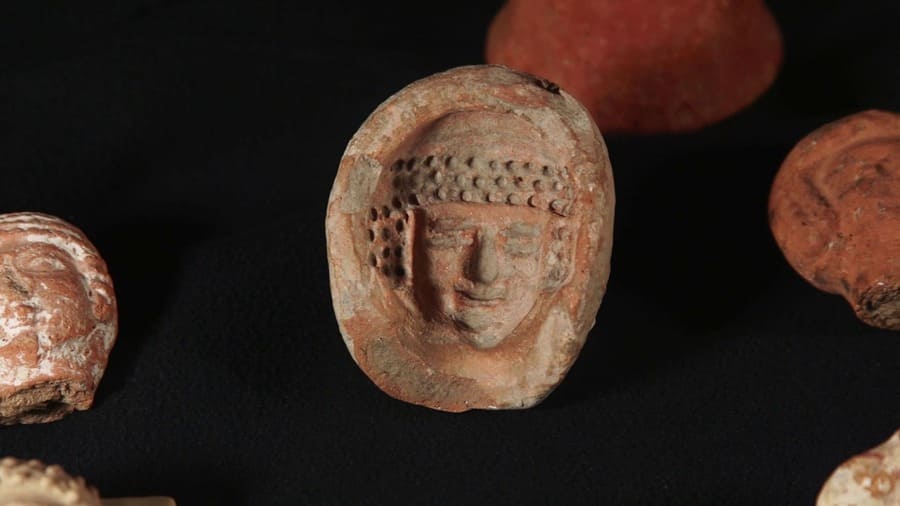

An exceptional discovery in Jerusalem. During archaeological excavations conducted by the Israel Antiquities Authority at the Kishle, within the grounds of the Tower of David Jerusalem Museum, a rare mould used for casting the face of a female figurine has come to light, dating to the First Temple period. The find emerged while sifting soil from fills and accumulations of that era. The excavations, ongoing for several years as part of the construction of the museum’s new Schulich Wing for Archaeology, Art and Innovation, have already revealed a continuous sequence of Jerusalem’s history, from the days of the Kings of Judah through to the British Mandate.

From soil to a reconstructed face
Following its discovery, the mould was handed to ceramics conservation specialist Tamar Gonen, who carefully cleaned away every grain of soil, revealing the delicate detail impressed within it. Conservator Sviatoslav Klindukhov then created a full cast from the mould, producing a complete reconstruction of the figurine’s face: clearly defined features and an elaborate curly hairstyle.
First Temple figurines: a debate that remains open
Clay figurines of this kind are known from almost every excavation conducted in Jerusalem and throughout Judah, dating between the 8th and 6th centuries BCE. Standing roughly 10 to 20 centimetres tall, they were made in two stages: the head and body were shaped by hand, while only the face was formed using a mould — which explains why most surviving examples are found broken at the neck. Archaeologists recognise three main types from the period: female figurines, known as Judean Pillar Figurines, typically shown with elaborate hairstyles and hands positioned beneath the breasts; horse-and-rider figurines; and zoomorphic figurines, mostly depicting horses. All were coated with a white slip and, according to surviving traces of pigment, originally painted in yellow, red and black.

Until now, no production mould for these figurines had ever been found in Jerusalem, leaving open the question of whether they were made locally or imported. “The discovery of this mould at the Kishle is therefore the first of its kind in Jerusalem, providing direct evidence that at least some of these figurines were produced within the city itself,” explains Dr Amit Re’em, one of the excavation directors.

Household amulets or images of a goddess?
The meaning and function of these figurines remain a matter of scholarly debate. As Debbi Ben-Ami, Curator of the Iron Age at the Israel Antiquities Authority, notes, the fact that they have been found in almost every household, as well as in streets and tombs, suggests they were objects of everyday use. They have previously been interpreted as representations of a fertility goddess — possibly Asherah — while others have suggested they were simply children’s toys. A further reading sees them as household amulets, intended to bring blessing, protection and good fortune. Researchers hope the newly discovered mould will help shed further light on these long-standing questions.

A dig open to the public
Eilat Lieber, Director and Chief Curator of the Tower of David Jerusalem Museum, described the excitement the find has generated among the team, noting that this summer visitors will be able to take part directly in the research by sifting soil from the Kishle excavations themselves.
📽️ VIDEO: Jerusalem: first-ever mould for First Temple period figurine faces discovered
Source: Israel Antiquities Authority
Questo contenuto è protetto da marcatura temporale decentralizzata. L’impronta digitale del testo è registrata per garantirne l’integrità e la data certa di pubblicazione.
Data di pubblicazione registrata: 27/07/2026 10:15
Verificabile in conformità con i protocolli internazionali di informazione certificata OpenTimestamps.