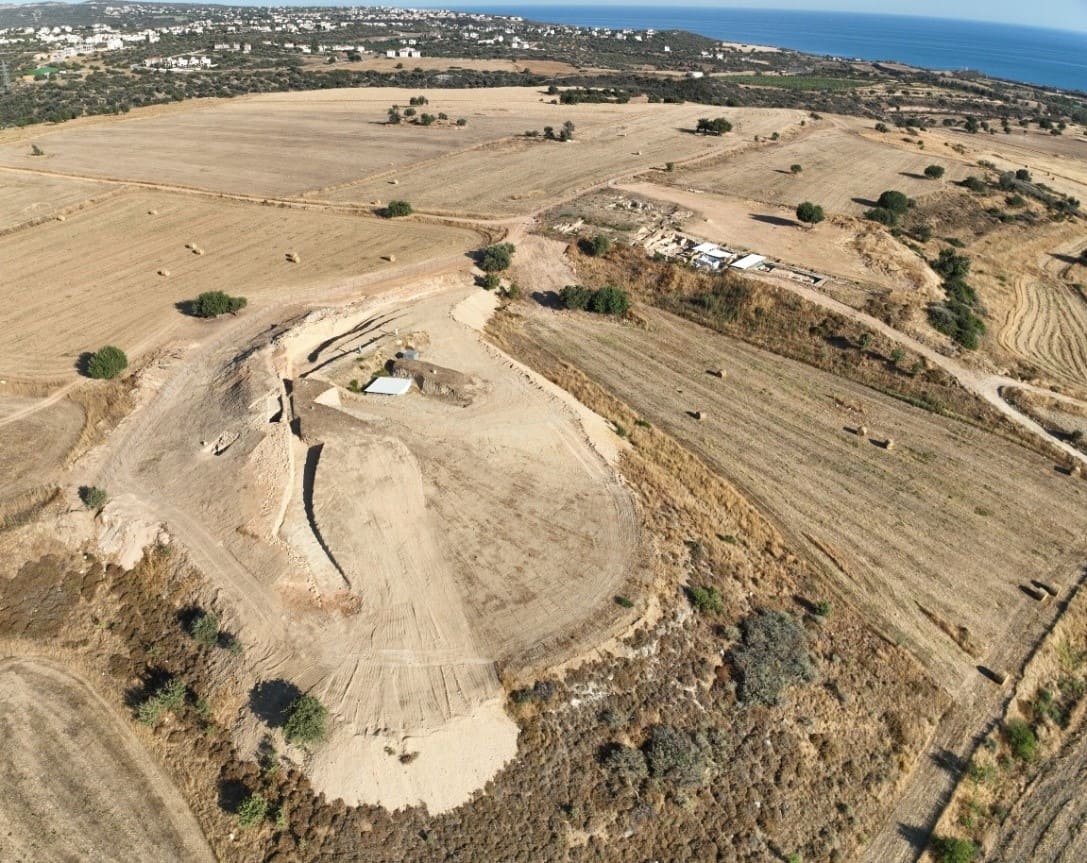

The archaeological landscape of ancient Palaipaphos, one of Cyprus’ most important Iron Age city-kingdoms, has just become significantly clearer. The Department of Antiquities of Cyprus has announced the completion of a major excavation campaign at Kouklia–Hadjiabdulla and Laona, conducted by the Archaeological Mission of the University of Cyprus under the direction of Professor Emerita Maria Iacovou.

©Department of Antiquities Cyprus
The results confirm the existence of an extensive fortification system surrounding the acropolis of Paphos during the Cypro-Classical period (5th–4th centuries BC). At the heart of the discovery are large, well-preserved towers and wall sections positioned between the Laona tumulus and the Hadjiabdulla plateau—evidence of a carefully planned defensive and administrative landscape that reflects the political ambitions of the Paphian royal dynasty.
A Fortified Acropolis in the Cypro-Classical Period
Excavation work, carried out in spring and autumn and completed in October 2025, revealed a monumental fortification wall with associated towers encircling the acropolis area. These structures are constructed of dressed stone and survive to heights of 1.40 to 2 metres—exceptional preservation for monuments of this period.

One of the most striking features is a newly uncovered tower at Laona. Almost square in plan (approximately 9 × 8.8 metres), the tower preserves not only its walls but also internal architectural elements. A broad staircase, complete with stone railings and brick-built treads, ascends along the inner face of the wall, indicating access to an upper level or roof. Such features are rarely preserved in Cypriot fortifications and suggest both defensive and symbolic functions.
South of the staircase, a narrow stone projection terminating in a carefully worked corner has been identified. Archaeologists interpret this as one of two controlled access points leading into the interior of the fortification system.
An Integrated Urban and Defensive Landscape
The newly revealed towers form part of a broader fortified zone that includes several major monuments already identified by the Palaepaphos Urban Landscape Project (PULP). These include the palatial complex at Hadjiabdulla, an adjacent workshop complex west of the palace, the Laona tumulus and an associated “pseudo-monument”, the massive Laona wall, five metres wide, with staircases preserved beneath the tumulus, and a complex of towers protecting the northeastern corner of the palace.

©Department of Antiquities Cyprus
Together, these structures define a carefully organized acropolis zone that separated the administrative and ceremonial core of the city from the extra-urban necropoleis beyond. The scale and investment involved point to a centralized authority with substantial economic and political resources.
Preservation Without Later Overbuilding
What makes Palaipaphos particularly exceptional is not only the ambition of its architecture but its survival. Unlike many ancient city centres, the Laona and Hadjiabdulla areas were not heavily overbuilt after around 300 BC, when the administrative focus shifted to Nea Paphos.
As a result, monumental walls, towers, palatial buildings, and workshops lie beneath as little as half a metre of agricultural overburden. Even the Laona tumulus—likely completed in the 3rd century BC—sealed earlier structures rather than destroying them. Beneath its eight-metre-high summit, the northern staircase of the great wall remains preserved to a height exceeding four metres, including its landing.

©Department of Antiquities Cyprus
Research, Training, and Long-Term Vision
The excavation also served as a major training ground for students of archaeology. Alongside the project’s permanent collaborators, undergraduate, postgraduate, and doctoral students from the University of Cyprus’ Department of History and Archaeology, as well as many graduates, participated in fieldwork, analysis, and documentation.
In parallel, the Department of Antiquities completed the installation of a unified protective fence around the expropriated plots in October 2025, ensuring long-term preservation of the urban fabric while research continues.

©Department of Antiquities Cyprus
Reassessing the Power of Ancient Paphos
Taken together, the discoveries at Laona and Hadjiabdulla represent one of the clearest archaeological expressions of royal power in Cypro-Classical Cyprus. The fortifications, towers, palace, and workshops were not isolated monuments but components of a deliberately structured political landscape.
As excavation and study continue, Palaipaphos is emerging not simply as a sacred or administrative centre, but as a fortified capital whose architecture projected authority, control, and permanence—qualities essential to a city-kingdom navigating the complex power dynamics of the eastern Mediterranean in the 5th and 4th centuries BC.
📘 Primary source
- 📄 Department of Antiquities of Cyprus official press release
Versione italiana dell’articolo