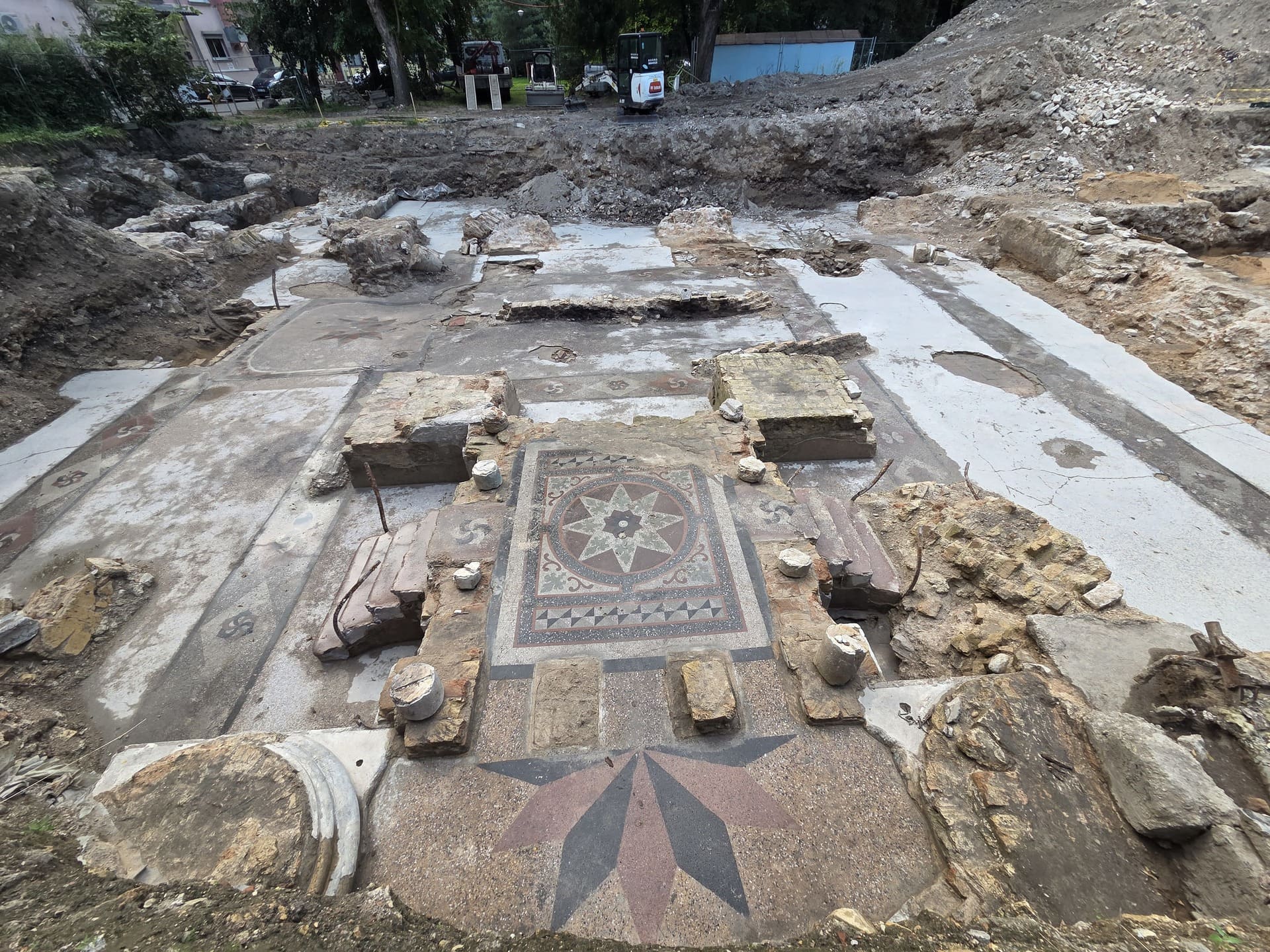

The Great Synagogue of Vilna, once the spiritual heart of Lithuanian Jewry, is gradually revealing its history once again. Archaeologists have now fully uncovered the synagogue’s monumental central bimah, together with new sections of the prayer hall and remarkable evidence of the vibrant Jewish community that flourished here for centuries before the building’s destruction during the twentieth century.

The heart of the synagogue revealed
The excavations, carried out by the Israel Antiquities Authority in partnership with Lithuania’s Kultūros paveldo išsaugojimo pajėgos, focused on the remains of the Great Synagogue of Vilna, closely associated with the renowned Vilna Gaon.
Destroyed first by the Nazi regime and later demolished under Soviet rule, the synagogue remained hidden beneath a school building for decades. Its recent removal has allowed archaeologists, for the first time, to expose extensive portions of the building’s central spaces.

Among the most significant discoveries are the monumental bimah, the main prayer hall, the women’s gallery, and beautifully preserved terrazzo floors decorated with geometric and floral motifs.


📽️VIDEO
The names of worshippers preserved
One of the excavation’s most moving discoveries consists of dozens of inscribed seating plaques identifying the permanent places reserved for worshippers.
Some belonged to women who prayed in the ezrat nashim, while others identified male worshippers and members of important charitable societies responsible for administering the Jewish community of Vilna.
Particularly noteworthy is a plaque commemorating a seat donated by Gitel Klachek, wife of the late Yechezkel, who served as the city’s shamash, or synagogue sexton responsible for practical and communal affairs. Historical records indicate that the Klachek family was among the city’s prominent Jewish families.

Evidence of centuries of religious life
Excavators also uncovered a small metal plaque engraved with the Ten Commandments, together with additional artefacts illustrating the religious and communal life that once centred on the synagogue and the surrounding Shulhoyf complex.

Archaeological investigations at the site began in 2011 and have now reached their sixth excavation season. The long-term project aims to preserve the synagogue’s remains, make them accessible to visitors, and safeguard one of Europe’s most important Jewish heritage sites.
According to the excavation directors, the newly exposed remains provide an almost personal connection with the generations of men and women who gathered here in prayer over several centuries.
Recovering a lost cultural landmark
The complete exposure of the central bimah marks a major milestone in the restoration and interpretation of the Great Synagogue of Vilna. Beyond its archaeological importance, the discovery represents a powerful act of historical remembrance, restoring part of the cultural identity of a Jewish community that was nearly erased during the Holocaust and the Soviet era.
As excavation and conservation continue, the site is expected to become an important place of memory, education and public engagement, preserving one of Eastern Europe’s most significant Jewish monuments.
📘 Source ✅
- 📄 Israel Antiquities Authority ✅
Questo contenuto è protetto da marcatura temporale decentralizzata. L’impronta digitale del testo è registrata per garantirne l’integrità e la data certa di pubblicazione.
Data di pubblicazione registrata: 04/08/2026 10:36
Verificabile in conformità con i protocolli internazionali di informazione certificata OpenTimestamps.